What is CO₂ actually?
CO₂ is often perceived as a harmful greenhouse gas. Carbon dioxide is, however, more than that:
- A natural building block of life
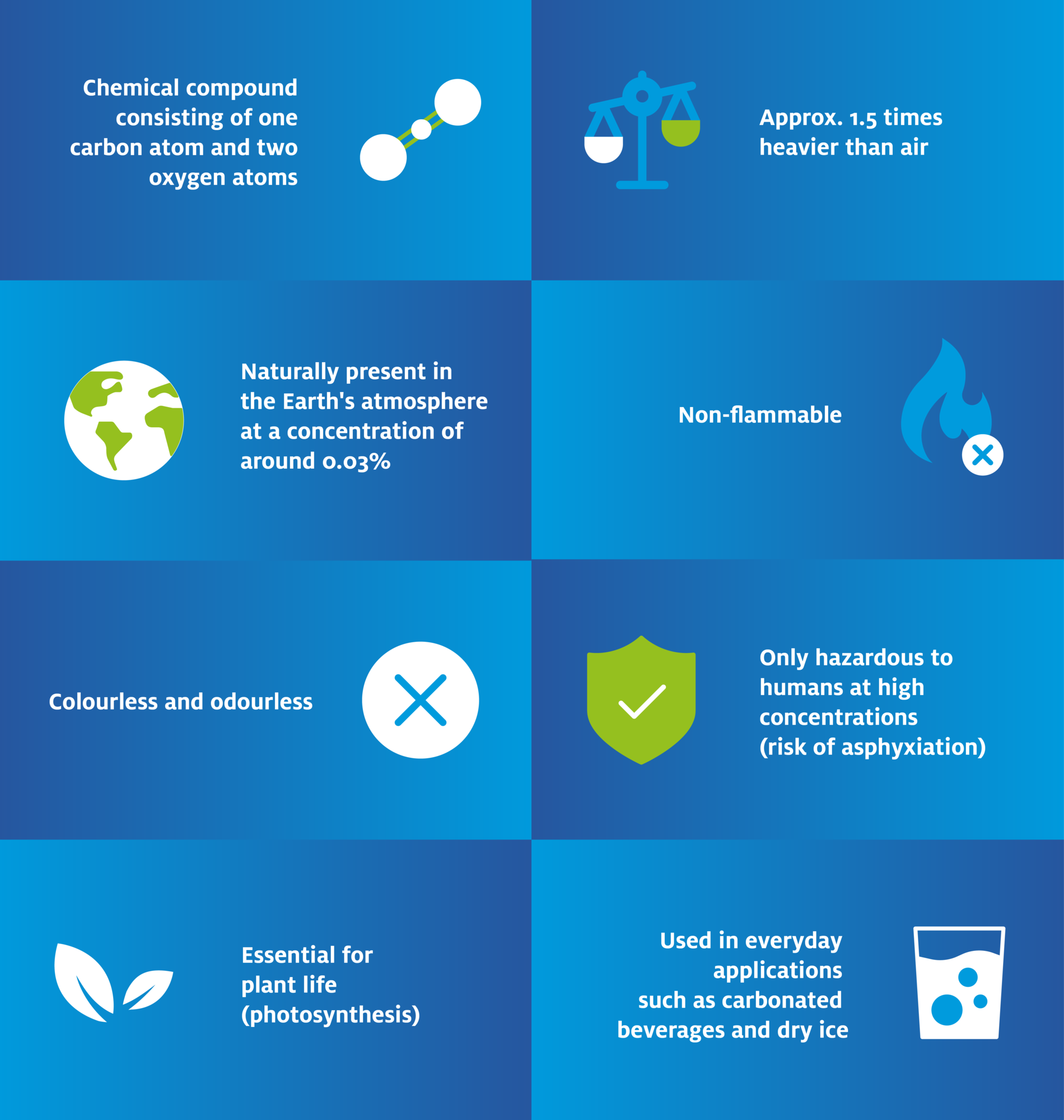
CO₂ is a colourless and odourless component of Earth's natural atmosphere. It is neither flammable nor toxic. As an essential substance of life, it is indispensable for plants, which need it for photosynthesis. - A valuable raw material
Carbon dioxide is also used in many industrial areas, for example in the food industry for carbonated beverages or in the chemical industry to produce dry ice. In the future, CO₂ will play an even more important role as a valuable carbon source. When used (CCU), it can replace fossil fuels and be processed to high-quality new products, significantly contributing to decarbonisation.
A proven and strictly regulated technology
Transporting CO₂ in pipelines is no new invention, but rather a proven technology. Worldwide, thousands of kilometres of CO₂ pipelines operate safely, a few of them being in operation for decades already – for example in the USA for enhanced oil recovery (EOR). Also in Europe, such projects have already been implemented successfully or are in the construction phase, such as for example in the Netherlands, where CO₂ is transported from the port of Rotterdam to depleted gas fields under the North Sea. CO₂ pipelines strongly resemble well-known natural gas or water infrastructure in terms of design and function. Just like existing gas pipelines, they are buried safely and invisibly underground.
In Germany and Europe, comprehensive technical standards apply for safety. The requirements are comparable with the very high norms for natural gas pipelines determined by the German Technical and Scientific Association for Gas and Water (DVGW - Deutscher Verein des Gas- und Wasserfaches e.V.) As an experienced network operator, we not only comply with these strict stipulations, but also actively contribute our expertise to developing these standards further.
What does EOR mean?
EOR stands for Enhanced Oil Recovery (tertiary oil recovery). With this well-established technique, CO₂ is injected into almost depleted oil and gas reservoirs to mobilise and extract the remaining oil. A considerable proportion of the CO₂ remains underground permanently. Experience gained over decades with this process provides valuable data that can be used for the safe operation of CO₂ infrastructure and storage in geological formations.
CO₂ can generally be transported in a gaseous or liquid form. For short distances and small quantities, trucks or trains can be used effectively. To move large industrial amounts safely and efficiently over long distances, CO₂ is compressed and transported in a so-called dense fluid phase through the pipeline. This is the proven and most economically viable technique, comparable with transporting natural gas or hydrogen.
The basic technology is very similar. A special characteristic of CO₂ is that it can have a corrosive effect on steel in contact with water, which is why all moisture is removed (“dried“) from the CO₂ before transport. The pipeline is also designed for higher operating pressures than a gas pipeline, achieved by using correspondingly thicker pipe walls. Our experience as a network operator, gained over decades, ensures that we have fully mastered these specific requirements.
Transparency and responsibility at a
local level
Projects like co2peline serve the common good because such projects make a significant contribution to decarbonisation. We are aware, however, the project's implementation can only succeed within the framework of an open dialogue amongst policymakers, CO2 emitting companies, the public and us as an infrastructure company. We are therefore committed to having early exchange among all stakeholders.
What are the risks and what precautionary measures are taken?
The safety of our infrastructure is of the highest priority. As with all technical systems, there are also comprehensive and proven safety concepts in place here for the extremely improbable event of a leak. As CO₂ is neither flammable nor toxic, there are no risks of an explosion or poisoning. The pipelines are monitored round the clock and are equipped, just like natural gas and hydrogen pipelines, with automatic shut-off stations. If a malfunction occurs, these stations immediately isolate the affected section and confine any possible leak to a very small amount.
The safety of the technology and a responsible approach towards the environment and local residents shape the basis for all our planning. But how is this technical project anquored in the political debate and how are key stakeholders involved in the dialogue?